Research papers typically require students to venture out into the world of academic literature in order to gain insight into a topic. Typically only reputable, peer-reviewed sources should be used to support your arguments. If you’re scared of the intimidating Elizabeth Dafoe Library (which you shouldn’t be), my guess is that you’ll probably venture on to Google to see what you can find on the topic you’re researching. Using a basic search engine, you’re going to find a whole lot of material that may be interesting, but not particularly useful. Sites like Wikipedia or Joe Blow’s Blog may be informative, but they don’t quite have the same clout as the publications of experts in the field you’re studying.
This isn’t to say that the Internet is useless when it comes to research. Not at all. However, when you’re on the lookout for reputable scholarly literature, try Google Scholar. This search engine will provide you with legitimate, peer-reviewed publications from the best and brightest.
Greg
Tuesday, October 24, 2006


Tuesday, October 10, 2006
Structured Procrastination
In case you blinked, October is in full swing. Where did all of September go? I doubt anyone has a reasonable answer for that. What is apparent is the fact that the number of days of stress-free university life students have managed to soak up these past few weeks are rapidly drying up. Perhaps you have been keeping on top of things, reading over notes from every class, starting all your assignments early, and going to see your profs with all you questions. Or maybe you had every intention of doing these things but somewhere along the way they lost priority to all other things in your life like soccer practice, the season premiere of Grey’s, and hanging out with friends, etc. Now faint recollections of meaning to review class notes are coming back and due dates that seemed so distant and manageable at the beginning of term are but a week or so away. October can be a hard in terms of getting yourself back into the swing of things and the only way to get the ball rolling…is to get the ball rolling. However if you feel your excellent procrastination abilities are impeding your ball rolling consider something called Structured Procrastination at www.structuredprocrastination.com. This is a neat skill that helps you to turn your procrastination into completed by using your procrastination skills in a valuable way. Does this sound too good to be true? Well it’s not as easy as sitting around doing no work but at least this one with help you get your assignments and studying done on time.
Friday, October 06, 2006
Conclusions – Will there be a sequel?
One of the biggest challenges student writers face is toward the end of the process. You’ve written everything except the dreaded conclusion. But what do you write? An all too common approach to conclusions is to summarize your entire paper. The trouble with a summary is that your instructor will be reading the same things they just read in the body of your paper. Especially for short papers written at the undergraduate level, reading a summary may be perceived as time well wasted.
I’ve struggled with conclusions for many years and have found the best way to tackle a paper’s conclusion is to think like some horror movie producers do:
leave room for a sequel! A great writer effectively answers question she’s asked herself but in the end, poses another with the hope that she or another researcher may be able to answer. Just as the monster comes back to life in the frightening final moments of a horror flick, prompting audience anticipation for a sequel, academic writers also might leave their endings open.
Greg
Blog note: Here's some more online information on conclusions.
I’ve struggled with conclusions for many years and have found the best way to tackle a paper’s conclusion is to think like some horror movie producers do:
leave room for a sequel! A great writer effectively answers question she’s asked herself but in the end, poses another with the hope that she or another researcher may be able to answer. Just as the monster comes back to life in the frightening final moments of a horror flick, prompting audience anticipation for a sequel, academic writers also might leave their endings open.
Greg
Blog note: Here's some more online information on conclusions.
Wednesday, September 27, 2006
Time management web workshop
I apologize for the sporadic nature of our posts. The weeks are just flying by.
When it gets busy we all struggle with time, the lack of it and the seemingly vast number of tasks that seem to pile up. Figuring out a game plan to deal with those tasks is always a good idea. The University of Guelph has a fabulous, interactive web workshop on time management. There are several points of entry: by topic (i.e. "time management and creativity") by persistent or recurring problems (i.e., procrastination) or by topics that are geared towards specific student populations (i.e., adult students or first-year students). Check it out.
When it gets busy we all struggle with time, the lack of it and the seemingly vast number of tasks that seem to pile up. Figuring out a game plan to deal with those tasks is always a good idea. The University of Guelph has a fabulous, interactive web workshop on time management. There are several points of entry: by topic (i.e. "time management and creativity") by persistent or recurring problems (i.e., procrastination) or by topics that are geared towards specific student populations (i.e., adult students or first-year students). Check it out.
Friday, September 15, 2006
Next Week's Workshops
The first full week back to school is almost complete and if you are starting to feel a little panicky about your ability to tackle assignments and organize your studying fret not!! The LAC will be offering a variety of workshops in the next two months that will set you well on your way and keep you on track to meet your goals this semester.
The LAC is offering two workshops next week. Note! If you have one of the LAC Brochures some of the rooms have changed! They are correct here.
Organizing Your Time Effectively
Tues. Sept 19, 1:30-2:30, Helen Glass 348
Wednesday, Sept. 20, 2:30-3:30, Helen Glass 344
This workshop will help with that constant pressure of getting everything done and getting it done on time.
Research and the Internet
Thursday September 21, 1:00-2:00, Helen Glass 370
This workshop offers information about using research logs and how to search the internet effectively. This involves sorting through all the junk and finding something valuable as well as making use of the databases available through the UM Libraries.
You can register by calling 480-1481 or online through the Virtual Learning Commons.
The LAC is offering two workshops next week. Note! If you have one of the LAC Brochures some of the rooms have changed! They are correct here.
Organizing Your Time Effectively
Tues. Sept 19, 1:30-2:30, Helen Glass 348
Wednesday, Sept. 20, 2:30-3:30, Helen Glass 344
This workshop will help with that constant pressure of getting everything done and getting it done on time.
Research and the Internet
Thursday September 21, 1:00-2:00, Helen Glass 370
This workshop offers information about using research logs and how to search the internet effectively. This involves sorting through all the junk and finding something valuable as well as making use of the databases available through the UM Libraries.
You can register by calling 480-1481 or online through the Virtual Learning Commons.
The Writing Tutor Program is back!!!!!
That's right! Starting Tuesday, September 19th, the writing tutors return to the Elizabeth Dafoe Library's Reference Room! Feel free to drop by for help with your essays. For updated information about hours of operation, please visit us online.
Greg
Greg
Tuesday, September 05, 2006
Welcome First Year Students and The Virtual Learning Commons
It's the first day of orientation! Welcome all first year students. When you have a chance come by and say hello and grab a candy out of our candy jar.
The University of Manitoba has a new and existing online initiative called The Virtual Learning Commons. This site provides academic information, and is extremely interactive with an assignment manager, a very cool scheduling feature, the ability to add your own "to-do" list (which can be added to your scheduler) access to an online writing tutor and the opportunity to chat online with other UM students.
Check it out!
The University of Manitoba has a new and existing online initiative called The Virtual Learning Commons. This site provides academic information, and is extremely interactive with an assignment manager, a very cool scheduling feature, the ability to add your own "to-do" list (which can be added to your scheduler) access to an online writing tutor and the opportunity to chat online with other UM students.
Check it out!
Monday, August 28, 2006
LAC Fall Workshops
The times, dates, and location of our fall workshops are now online. Our first one is on September 12 at 1:30 (Taking Useful Class Notes). The same workshop is repeated on September 13th in 344 Helen Glass at 2:30.
If you want to register please call 474-1481.
If you want to register please call 474-1481.
Wednesday, August 23, 2006
What counts as cheating?
In every class you take the professor starts by rattling on about plagiarism. Who actually reads that long, dense paragraph, or goes to the university’s academic dishonesty policy, anyway?
You should!
What may seem like a minor infraction of the academic dishonesty policy can get you a big, fat goose egg on an assignment or even get you cashiered out of a course. For a quick way to get your head around this issue, try the Student Advocacy web site’s online quiz.
Kris
You should!
What may seem like a minor infraction of the academic dishonesty policy can get you a big, fat goose egg on an assignment or even get you cashiered out of a course. For a quick way to get your head around this issue, try the Student Advocacy web site’s online quiz.
Kris
Monday, August 14, 2006
Reference Librarians
The first time you walk into Elizabeth Dafoe Library can be a little overwhelming. As the largest library in the province, it isn’t easy finding what you need. Thank goodness for the friendly and helpful Reference Librarians. The reference desk is located straight ahead of you when you walk into the library, and they are happy to help you find what you’re looking for. They also offer occasional library tours/orientations and have maps for students. So whether your need periodicals, microfilm, photocopiers, dissertations, government documents, writing tutors, computer labs, newspapers, collections or a nice quiet carrel to study at, the Reference Librarians are there for you!
Greg
Greg
Wednesday, August 09, 2006
Critical Comma
I'm often caught grumbling about picky people and commas, but Rogers Communications Inc. just found out that a misplaced comma can be costly. Maybe I need to stop grumbling.
(Thanks to Neil Gaiman for pointing this article out on his blog.)
Miriam
(Thanks to Neil Gaiman for pointing this article out on his blog.)
Miriam
Tuesday, August 08, 2006
Making the Most of Group Studying
Studying with a group is fun, and can be very productive. Actually, it can often be the best way to approach a particular subject area. However, managing group study time can be challenging.
If you are anything like me, staying on task in a group is difficult. For example, I have a hard time staying focused when my study group insists on making jokes about chickens and roads. The temptation to be distracted by very corny jokes, discussions about great parties, and why most of the profs on campus are completely unreasonable is high. If you find that you can’t bring people back to task with a topic-related question, or that your group is too easily distracted, try moving to a quieter study area with fewer distractions. Ultimately you need to understand the material. If the group continues to be dysfunctional, find another group, or study on your own. Remember, chicken jokes will not impress a professor on a final exam.
To focus your group, try some of the following tips:
for how to study effectively in groups
and
for why study groups work...
Kris & Anita
Studying with a group is fun, and can be very productive. Actually, it can often be the best way to approach a particular subject area. However, managing group study time can be challenging.
If you are anything like me, staying on task in a group is difficult. For example, I have a hard time staying focused when my study group insists on making jokes about chickens and roads. The temptation to be distracted by very corny jokes, discussions about great parties, and why most of the profs on campus are completely unreasonable is high. If you find that you can’t bring people back to task with a topic-related question, or that your group is too easily distracted, try moving to a quieter study area with fewer distractions. Ultimately you need to understand the material. If the group continues to be dysfunctional, find another group, or study on your own. Remember, chicken jokes will not impress a professor on a final exam.
To focus your group, try some of the following tips:
- set a goal of how much material you will cover
- identify key definitions and quiz each other
- each person come up with a possible test question; then try to answer the questions
- work on the sample problems and share the process/solution
- each person come up with a memory aid to learn a different part of the course content
- if course content is controversial, set up a debate and back up your positions with material from readings and lectures
for how to study effectively in groups
and
for why study groups work...
Kris & Anita
Thursday, August 03, 2006
Online Encyclopedia
If you’ve ever had trouble trying to confirm a fact and don’t have a lot of time to hunt through the Internet, try looking at Wikipedia (www.wikipedia.org). It is an international, web-based, free-content, multi-language encyclopedia. Wikipedia material is written by volunteers and the content can be changed by anyone. The benefit is that you are reading information often written by an expert who is keen on the subject. The disadvantage is that not all the content is 100% accurate. However, Wikipedia can be a great quick reference for finding many facts or getting a general understanding of a topic.
Kris
Kris
Monday, July 31, 2006
Refworks
“Your Online Personal Database and Bibliography Creator”. Tired of trying to learn a new style of citation for every paper you write? Refworks formats your paper and bibliography for you and is free for U of M students. Access the website through library's website (or click on "Refworks" above).
Greg
Greg
Thursday, July 27, 2006
Use a professor's office hours
You know the first day of class when the professor explains the marking scheme and announces office hours? Believe it or not, those office hours are like gold! You get almost unrestricted access to an expert in a particular field. To get the kind of tutoring, advice and tips you can get from a professor during office hours, companies and individuals are willing to pay hundreds or thousands of dollars. The professors know what will be on the your exams and they know where you are likely to have problems, so use a professor’s office hours to your best advantage.
Kris
Kris
Monday, July 24, 2006
Music for Study?
Most of the people I know study while listening to music. While there have been studies to show that listening to music can be beneficial, the research in this area is still inconclusive. So, most experts (mostly psychology professors) say that studying to music is good if it’s relaxing and doesn’t split your focus. If you need music to study, then music without words such as classical, instrumental or even those sounds of the rain forest CDs is suggested.
Kris
Kris
Thursday, July 20, 2006
Need to polish your writing skills?
The New Humanities Reader offers a series of 14 tutorials aimed at helping students improve their writing skills. Each tutorial highlights a different aspect of the writing process. Check it out:
Monday, July 17, 2006
E-Resources
I've become frustrated with my dictionary, which, because it's five years old, is already obsolete and does not include new words, such as "cybrarian", "hacktivism", or "yada yada". Rather than buying a new dictionary (too expensive!), I've been using the Oxford English Dictionary online, which is available to students through the U of M libraries website. Check out the other online dictionaries and encyclopedias to which the U of M subscribes at http://umanitoba.ca/libraries/elibrary/ebooks_etexts.html
Wednesday, July 12, 2006
A Word A Day
Want to increase your word power? Check out "A.Word.A.Day" (AWAD) at http://wordsmith.org/awad/subscriber.html Sign up at this site and receive a daily email with a definition, examples of how the word is used in contemporary English, and a link to an audio pronunciation. AWAD mailing list addresses are never sold, rented, leased or traded, so no worries about junk mail. I particularly enjoy the quotations at the end of each entry!
Wednesday, May 24, 2006
Complex Sentences
Many people have trouble putting the wonderful and complicated ideas they’ve developed onto paper. When they read what they’ve written they wonder why the ideas don’t “flow” or why the sentences don’t seem to express the full complexity of the ideas.
One way to fix this lack of flow is to diversify sentence structure. Most students will be familiar with the simple sentence. (Eg: Margot loves doing dissections!) This sentence has a noun (Margot) and a verb (loves) and expresses a complete thought. This is also called an independent clause.
Another kind of sentence is the compound sentence. (Eg: Margot loves doing dissections, and she gets to do one this week.) This sentence has two parts which are of equal weight and are joined by a coordinator (for, and, nor, but, or, yet, so). This type of sentence joins two ideas by using a conjunction, but both ideas could have been expressed independently and still have the message conveyed properly.
The complex sentence is a real gem of the English language. This type of sentence’s true value is its ability to express intricate concepts by establishing dependent relationships between ideas. Sounds hard, eh? It’s truly not. Complex sentences are just the next logical step after compound sentences.
A compound sentence puts two independent clauses together with a joining word. A complex sentence, on the other hand, uses something called a dependent clause. A dependent clause is similar to an independent clause but it cannot stand alone as a sentence. In practical terms, this means that one part of the sentence (the dependent clause) relies on another part of the sentence (the independent clause) for complete meaning.
For example:
Although Hamlet appeared insane, his soliloquies provide evidence to the contrary.
When Columbus voyaged across the Atlantic, many people thought him to be mad.
The king of France declared war even though his advisors were against it.
In each of these examples, it is possible to determine relationships between ideas. Complex sentences can show time, cause/effect and contrasting associations. In the first example, we are contrasting Hamlet’s apparently insane behaviour with the heartfelt introspection when he his alone. Using a complex sentence in this way directly links the two ideas and helps increase the “flow” of the writing.
Dependent clauses in complex sentences are often used as adverbial modifiers – meaning they modify or restrict the meaning of a sentence. In this case, they require commas. For more information about comma use, check out the blog “Commas”.
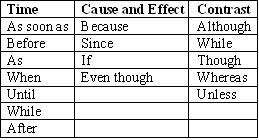
The chart above provides some key words and phrases that are helpful if you wish to add complex sentences to your work. An essay with a variable sentence structure is easier to read, and using complex sentences provides a writer with the tools to express intricate thoughts.
References: (MLA style)
Aaron, Jane E. & Murray McArthur. The Little, Brown Compact Handbook, 2nd ed. Toronto: Pearson Education Canada, 2003.
Hacker, Diana. A Canadian Writer’s Reference, 2nd ed. Scarborough: Nelson Thomson Learning, 2001.
Kris
One way to fix this lack of flow is to diversify sentence structure. Most students will be familiar with the simple sentence. (Eg: Margot loves doing dissections!) This sentence has a noun (Margot) and a verb (loves) and expresses a complete thought. This is also called an independent clause.
Another kind of sentence is the compound sentence. (Eg: Margot loves doing dissections, and she gets to do one this week.) This sentence has two parts which are of equal weight and are joined by a coordinator (for, and, nor, but, or, yet, so). This type of sentence joins two ideas by using a conjunction, but both ideas could have been expressed independently and still have the message conveyed properly.
The complex sentence is a real gem of the English language. This type of sentence’s true value is its ability to express intricate concepts by establishing dependent relationships between ideas. Sounds hard, eh? It’s truly not. Complex sentences are just the next logical step after compound sentences.
A compound sentence puts two independent clauses together with a joining word. A complex sentence, on the other hand, uses something called a dependent clause. A dependent clause is similar to an independent clause but it cannot stand alone as a sentence. In practical terms, this means that one part of the sentence (the dependent clause) relies on another part of the sentence (the independent clause) for complete meaning.
For example:
Although Hamlet appeared insane, his soliloquies provide evidence to the contrary.
When Columbus voyaged across the Atlantic, many people thought him to be mad.
The king of France declared war even though his advisors were against it.
In each of these examples, it is possible to determine relationships between ideas. Complex sentences can show time, cause/effect and contrasting associations. In the first example, we are contrasting Hamlet’s apparently insane behaviour with the heartfelt introspection when he his alone. Using a complex sentence in this way directly links the two ideas and helps increase the “flow” of the writing.
Dependent clauses in complex sentences are often used as adverbial modifiers – meaning they modify or restrict the meaning of a sentence. In this case, they require commas. For more information about comma use, check out the blog “Commas”.
The chart above provides some key words and phrases that are helpful if you wish to add complex sentences to your work. An essay with a variable sentence structure is easier to read, and using complex sentences provides a writer with the tools to express intricate thoughts.
References: (MLA style)
Aaron, Jane E. & Murray McArthur. The Little, Brown Compact Handbook, 2nd ed. Toronto: Pearson Education Canada, 2003.
Hacker, Diana. A Canadian Writer’s Reference, 2nd ed. Scarborough: Nelson Thomson Learning, 2001.
Kris
Subscribe to:
Posts (Atom)
